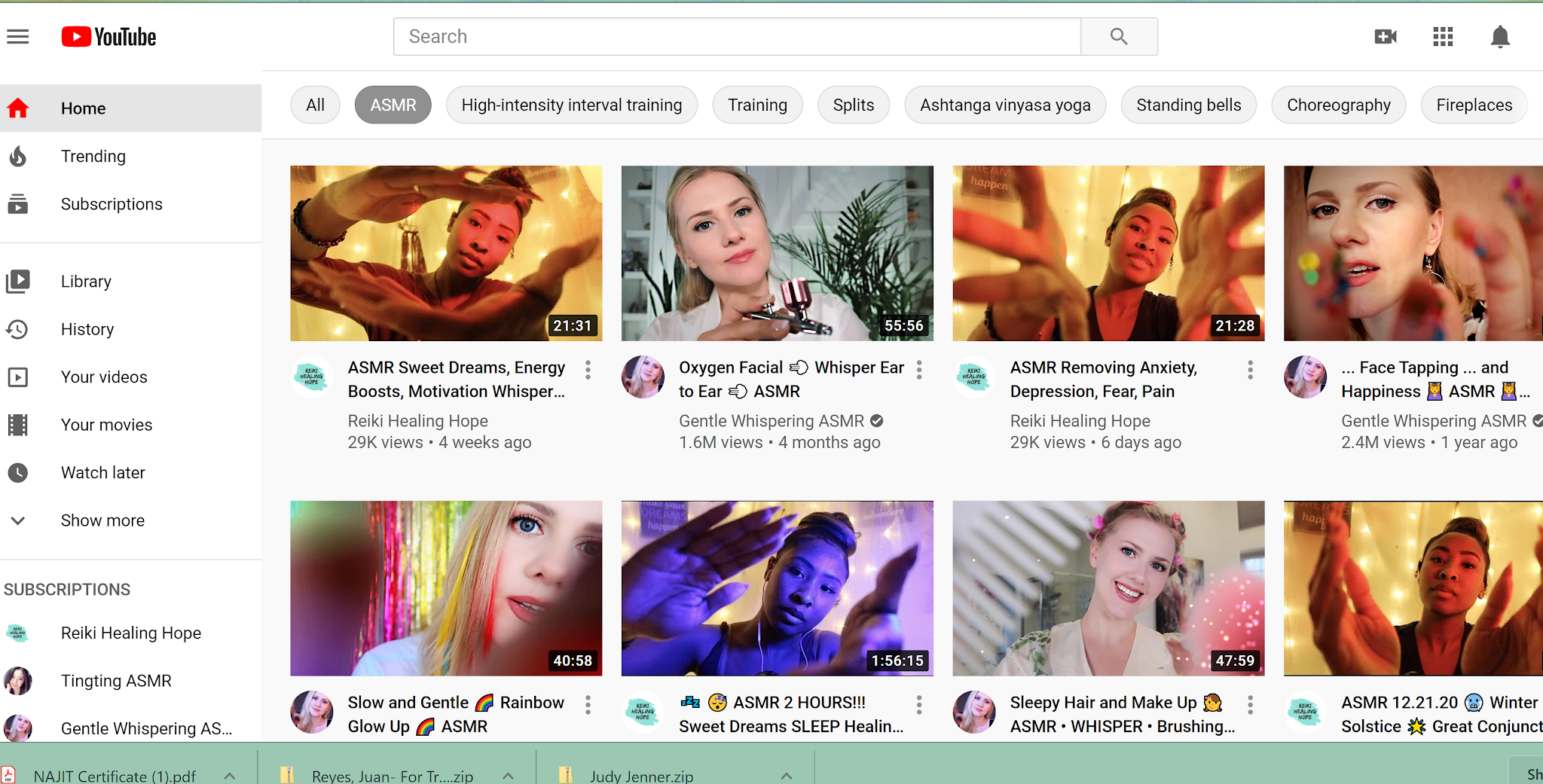
We've recommended ASMR to many friends and colleagues, and one dear friend used it the night before the written portion of the FCICE (federal court interpreter certification examination), and she loved it -- and she passed! She is now also addicted and she says it's absolutely our fault, and we are happy to take the blame for this healthy addiction. Some has asked us why it wouldn't be good to just listen to the sounds of nature (available on many apps such as Calm), and while we love those, too, ASMR is a bit different and almost feels like hypnosis (in a good way, we promise). We've gone down the YouTube rabbit hole quite a bit, and have also discovered Reiki sessions (Reiki Heiling Hope is a good one), but we prefer ASMR. Here are two of our favorite ASMR channels: TingTing and Gentle Whispering. There are hundreds of others out there for you to discover. Enjoy and you are welcome!
ASMR and the interpreter
We know, we know: it's been a hard year and we haven't posted much in 2020, but we are wrapping up the year with some posts that we hope you find useful. If you've never heard of ASMR and you are an interpreter/translator/hard-working linguist/work in any other profession, you are in for a treat. We are aware this ASMR thing sounds quite esoteric, but hear us out and try it if you'd like so you know what all the buzz is about. Just to define the acronym: ASMR stands for autonomous sensory meridian response and the best we can do to describe it is that it's a form of meditation/relaxation that includes a tingling sensation that's very, very relaxing. It's one of those things you just have to try out for yourself. Once we did, we were hooked. Dagy read about ASMR for the first time in a major Austrian newspaper a few months ago. We were a bit skeptical at first, but Dagy tried one of the YouTube channels that was recommended in the article, and could absolutely feel the relaxing effects immediately. Judy also jumped on the bandwagon and now we both listen to a few ASMR videos before going to sleep every single night. It really does work for us (meaning we can feel the "tingling" sensation ASMR is supposed to evoke), and turns out ASMR is quite the phenomenon these days. Basically, ASMR involves so-called brain triggers in the form of gentle sounds (tapping, etc.), gentle whispering, or a combination of both.
Zoom simul: Learning to embrace imperfection
As a follow-up to our post on consecutive interpreting via Zoom, we are now featuring a guest post by the wonderful team of interpreters behind trying to teach us all how to use the simul interpreting function in Zoom. Without further ado, please read below for this guest post by Ernest Niño-Murcia (his bio is at the very end of this post).
Once they accept, they are given a simple interface that controls which channel their output is going to be heard in:
The rest of the participants are then presented with the option of choosing an audio channel for purposes of interpretation:
Ernest Niño-Murcia is a federally certified Spanish court interpreter, conference interpreter and interpreter trainer based in Des Moines, Iowa, USA. He is currently interpreting Governor Kim Reynold's biweekly press conferences live over the air for Iowa PBS. Additionally, Ernest is a Jeopardy! Champion (2012), whose greatest achievement on the show was beating an attorney to the buzzer to answer "co-defendant" in the "11 letter words" category.¨
The current pandemic has made Zoom's video conferencing technology suddenly ubiquitous. Something that you maybe did a webinar on a few times per year is now an everyday resource and a key part of colleagues' livelihood. In a stroke of fortuitous timing, right about the time the outside world started locking down, some colleagues and I discovered that Zoom offered a simultaneous interpreting feature within its platform. Extremely curious (and suddenly with a lot of time on our hands) we logged on with a and began experimenting. We grew our knowledge of the platform through these working sessions and also by eventually hosting demos for other colleagues, finding that teaching also helped us learn. Soon after we were doing our first paid jobs via Zoom simultaneous. We’d like to take this opportunity to reflect and share some points from our experience learning, teaching and using Zoom’s simultaneous function.
![]() |
| Photo by Ernest. Civil mediation session featuring interpreter interface. Shared with permission. |
For those of you who aren’t familiar with Zoom's simultaneous interpretation capabilities, here is the elevator pitch version (maybe slightly longer. Long elevator ride in a big building or the elevator gets stuck but not for so long that you start to freak out). Note that this is a general overview and not an exhaustive how-to. The exact how-to of setting up and running interpretation in a Zoom meeting is laid out in Zoom’s official instructions. A Zoom user with an eligible paid account (for individuals, the cheapest would be a Pro plan with webinar add-on totaling about $55/month) can enable interpretation account-wide and then as a feature in a particular meeting or webinar. Once actually in the meeting, the person who set the meeting (known as the host) can turn on interpretation and designate one or more of the participants to act as interpreter(s) to/from one or more of the designated languages. The interpreter then sees this notification:
Once they accept, they are given a simple interface that controls which channel their output is going to be heard in:
The rest of the participants are then presented with the option of choosing an audio channel for purposes of interpretation:
Selecting a channel allows participants to listen to the interpreter when they are working into that language, as well as hear the other participants in their channel and possibly participants in the other channel (if they choose). Once the interpreter is set up and participants have chosen their channel, you can be off and running with a multilingual meeting that is being interpreted seamlessly for all parties in real time.
Sounds like a dream solution that will revolutionize the way we work and do business, right? Well, yes and no.
- While Zoom offers a smooth, affordable solution for simple interpreting assignments, it is still at its core a videoconferencing platform with an interpretation feature grafted on, in contrast to existing remote simultaneous interpreting platforms built from the ground up specifically for interpreting. This distinction is especially highlighted by the fact that INTERPRETERS CAN’T HEAR EACH OTHER in Zoom, with serious implications for team interpreting and relay. Monitoring your interpreting partner will require some ingenuity on your part (and a second device). There are additional issues to take into account.
- To participate in an online event interpreted through Zoom in any role (speaker, listener, interpreter, host) participants cannot receive their audio via a phone line or connect via Zoom´s simplified browser interface. These options that make conventional Zoom events more accessible actually become obstacles to effective simultaneous and necessitate client education. Menus and buttons will look different depending on whether people are connecting via a tablet, smartphone or computer (all with Zoom downloaded).
- Zoom's option to designate an interpreter by their email before the event can run aground if that email isn´t connected to the Zoom account that person then uses to join the meeting. These are not insurmountable obstacles, but they do highlight the need for careful study and practice on the platform before you attempt to do it live.
- Once you fully understand not just how Zoom simultaneous works but how it can break down, you can give clear guidance to clients at different stages of the planning process if you are given a seat at the table, from determining which platform to use (and that may mean steering them away from Zoom), to instructing participants before the meeting to ensure a smooth launch and walking people through the various functions once in the meeting. Note that this is a value-added service that goes beyond the scope of interpreting and should be compensated accordingly (especially if your event is hosted on the Zoom account you are paying to maintain).
We received a message from a colleague who received a last-minute request from a client to interpret an event via Zoom. While we were able to guide him through the basics of hosting, interpreting and listening, the meeting was still a failure because of a lack of knowledge and guidance for the client.
When we asked how the meeting had gone, he wrote:
The people my client is working with set up the call and, of course, didn't know to enable the interpretation prior to the meeting. When I got on, I told them about it. They made me a cohost figuring that I could set it up on my end but, of course, I couldn't... My client assured me that this will never happen again.
We invite you to watch a video of our recent webinar for the University of Arizona, ¨Expand your Toolkit: Zoom for Remote Simultaneous Interpreting¨ and reach out to us at training@TEAlanguagesolutions.com if we can be of assistance in helping you master this new tool.
Ernest Niño-Murcia is a federally certified Spanish court interpreter, conference interpreter and interpreter trainer based in Des Moines, Iowa, USA. He is currently interpreting Governor Kim Reynold's biweekly press conferences live over the air for Iowa PBS. Additionally, Ernest is a Jeopardy! Champion (2012), whose greatest achievement on the show was beating an attorney to the buzzer to answer "co-defendant" in the "11 letter words" category.¨
Jobs: Spanish court interpreter (federally certified) in Laredo and Brownsville, TX
We recently received a notification from the Southern District of Texas that two US District Courts have vacancies for federally certified Spanish interpreters, which we are happy to share here. These sound like great opportunities for federally certified Spanish interpreters who might want to make the switch from freelance to full-time in-house employment. As much as we love running our own business, we can certainly see how attractive it would be to work in-house, especially during these unprecedented times. We have not yet been to the US District Court in either Laredo or Brownsville, but the folks who sent us this announcement seem very nice! We might also be a bit biased, as we spent some time in Texas as kids and have many fond memories.
Please refer to the link for any additional information, as this is all we have on our end. Here's the link again. Please keep us posted if you apply for one of the positions and/or get hired -- it would be fantastic if one of our readers landed the job. Feel free to share with your network. Best of luck!
Jobs: Spanish court interpreter (federally certified) in Del Rio, TX
We know this pandemic has been very tough for many freelance linguists, especially those who focus exclusively on interpreting (we do both interpreting and translation and while both have suffered, it's nice to have two income streams). We've heard from several long-time freelance court interpreters that they are beginning to look for in-house positions, of which relatively few exist here in the United States. We've got some good news for those fellow court interpreters who are federally certified (Spanish): the US District Court in Del Rio, Texas, has four full-time staff positions (pay is up to $104,000) that they are trying to fill, and we are delighted to share the job posting here.
A quick note on how this posting reached us. Judy is a federally certified Spanish court interpreter and had received several emails from the very friendly staff at the Del Rio court to invite her to come interpret for a few days earlier this year. Unfortunately, the dates didn't work out and Judy wasn't available, but all the interactions we've had with the court have been lovely, so based on that limited interaction, we'd definitely recommend having a look at this job posting. As you might guess, Del Rio is located at the Texas-Mexico border.
Please keep us posted if you apply and/or get one of these positions - we'd love to share the success story here.
Interpreting depositions via Zoom
It's been a while since we have posted, and we hope you forgive us. After more than 10 years and 500+ blog posts, we'd run out of ideas a bit, and there are now so many other excellent blogs for translators and interpreters that we thought we'd take a break. But now that we are in lockdown due to COVID-19, we have some new ideas for topical issues. Today's topic is about interpreting depositions via Zoom and whether that's possible and how it all works. Here's Judy's experience from the United States, where she's a court-certified (Nevada, California, federal) Spanish interpreter and a veteran of more than 1,500 depositions. Please note that depositions seem to be unique to the U.S. legal system, but this information is still useful for other types of proceedings that now have to be interpreted remotely.
We'd love it if this blog post could serve as a repository for information and tips on how to best interpret via Zoom, so please share your comments below. Please note that this blog post is not about interpreting using Zoom's simultaneous interpreting function, as we have not yet tested it and clients haven't requested it. For better or for worse, this is about consecutive interpreting via Zoom.
![]() |
| My set-up. Yes, I cleaned my desk for you. |
The basics
It took clients, mainly law firms and court reporting firms, a few weeks to get systems set up to hold depositions remotely. Most of my clients use Zoom or Remote Counsel that also runs on Zoom. I did my first depositions via Zoom in mid-March and have been doing one a week or so since then.
- Download Zoom. If you have never used Zoom before, make sure you download the software here. It's super quick and easy, but it's your responsibility to make sure everything works. If you need tech support, consider hiring someone to help (remote, of course). If you don't know your way around Zoom, be sure to watch a quick tutorial. First order of business: locate the "mute" button and remember that you are on camera unless you switch it off. You don't want to make news like this one (humor is much needed these days). You may have read about some Zoome privacy issues in the last month or so, and our friends Alex Drechsel and Josh Goldsmith over at techforword have a great summary here.
- Basic computer set-up. Many interpreters have never done any sort of remote work, and that's of course absolutely fine. If you are ready to take remote work during this crisis (and now that in-person work is basiscally non-existent), make sure you have the basic set-up. You don't need much other than a computer and a camera (most laptops have an integrated camera). If you use a desktop computer, you can purchase an inexpensive external video camera. I also have a small cover for the camera so I can slide the cover into the closed position on my laptop when I am not using it (for privacy reasons). Mine is similar to this one. Make sure you have a quiet space to work, even though I know this can be a challenge these days. I have a dedicated home office and I put my dogs away before starting as they love, love, love to bark at inconvenient times.
- Headset. In order to have good incoming and outgoing audio, you should wear a headset (the other option is a good free-standing mic, but most won't have that). I use an older model of this Jabra that I purchased years ago to do RSI (remote simultaneous interpreting) and it's served me well. Our lovely colleague Alex Drechsel has an amazing blog post on headsets here (a must-read). In addition, Tamber Hilton did excellent video reviews of headsets for both Mac and PC. I'm currently thinking about upgrading my headset because I want integrated hearing protection (such as PreservEar) to prevent acoustic shock, and I am currently exploring options. We will report on this journey in another blog post.

They really wanted to stay, but no!
Ready, set, go!
![]() |
| Image credit: Canva |
- Who's in charge of tech issues? Some of our clients, mainly court reporting firms, have put together handy informational sheets on how to best use Zoom and how to guarantee audio quality. This usually gets sent to all parties, but not everyone follows these suggestions. Other times, individual lawyers have contacted us asking for help because they've never done this before. We usually say that it's ideal that all parties use Zoom online (computer or mobile devices) rather than calling in, which is unfortunately also an option that makes for bad audio and no video. We don't like to make things too complicated for clients who may be overwhelmed by this process, but we emphasize that it's ideal if all parties wear a headset and to avoid cell phones that get put on speakerphone (I've had to make that work, too). None of my assignments have gone so badly that we've had to log off, but some have been tough. In general, I'd say that everyone is in charge of their own tech, but you can't interpret what you can't hear, so if the audio quality is poor, you must speak up. The court reporter will want that, too, but she/he will usually have the added benefit of a recording, while you need to make it work in real time.
- Identify yourself. I recently took a fantastic webinar with Steven Mines about interpreting via Zoom, and I learned that you can change your default name in Zoom (by right-clicking on your name, instructions are here). This is great because I add "interpreter" in front of my name so everyone easily knows who I am. So now I am "Interpreter Judy Jenner."
- Ask participants to speak one at a time. For those of you who have done quite a few depositions, you know that this is a challenge. I've rarely been in one where people DON'T talk over each other. This has been surprisingly better when doing depositions remotely, but it's a good idea to briefly remind the parties before you start that speaking one at a time is crucial. Ask the attorneys for their permission to communicate the same thing to the deponent in the other language.
- Consecutive only (but there is a simul function in Zoom). Yes, we know: In most depositions, we whisper interpret the question into the deponent's ear and do sim-consec or straight short consec for the responses (preferences vary; but that tends to be the method that most interpreters and attorneys favor). Online you will have to do everything in consecutive mode, which is quite a challenge for those of us who don't do a lot of long consecutive. Some deponents are long-winded, but in person they will make natural pauses to allow you to interpret. In may experience that hasn't been the case much online. I've realized that I go through a lot of paper (I used recycled paper) and that my note-taking technique is average at best, which is why I've signed up for an AIIC course with David Violet this coming Saturday (held via Zoom!). If you are a bit hestiant to do consecutive, you might want to practice first using Speechpool videos (among other fantastic resources).
- All the normal rules and the codes of ethics still apply. The setting will be more informal because you are at home, but the rules are the same. Arrive early (I still shoot for 15 minutes and hear crickets for most of the time, but it's always good to be early!) and well prepared. Have water, paper, pens, etc. nearby. Dress appropriately. Interpret in the first person and when you speak to ask for repetition, use the third person. You all know the drill, but sometimes it's good to remind yourself of the basics. Ask for breaks if you need one -- just like in real life, it's unreasonable to go for three hours without a break.
- Team interpreting. Unfortunately, I have yet to do team interpreting for any deposition, ever. I work mostly in Nevada and we sadly haven't been able to convince clients that team interpreting is the standard. Now we have the chance to do it with online depositions, which are indeed more exhausting than in-person events. I've brought this up to several clients and have made a case for team interpreting while also presenting the great argument that having two interpreters online is ideal in case one has tech problems. No one has agreed to this yet, but I will keep on asking. In accordance with best practices and recommendations from all leading T&I associations, we really should only interpret 30 minutes at a time before switching with a partner, which can, by the way, be more of a challenge online.

Time is always an issue. Image credit: Canva. - Same or increased rates. This is not the time to lower your rate -- quite the contrary. It might be a good idea to increase your rate a bit to reflect the extra tech effort and cognitive load that's part of interpreting online. I know it is tempting to reduce your rate now that you have less work, but I strongly advise against it. Of course you should also enforce your usual cancellation rules. I've had several depositions cancel at the last minute and I've always been able to enforce my 24-hour cancellation policy.
- Unexpected. During in-person assignments, you don't have time to look up terminology (unless it's during a break), but turns out that in spite of the additional cognitive load, I did have the time to briefly double-check a term or two during the assignment, which was something I didn't expect. I have many fantastic online versions of dictionaries installed and also via subscription, and the one I use the most is Wordfinder (fee-based) as it allows me to search across many different resources at the same time.
Final impressions (for now)
Even though I've had some audio issues, including a deponent who was clearly outside on a cell phone speaker phone in what sounded like heavy traffic and having to rip my headset off my head a few times when high-pitched noises came out of nowhere, my experiences interpreting depositions via Zoom have been mainly very positive. I was afraid of how we'd handle exhibits and sight translation, because when interpreting in-person you usually get a copy of the document you are asked to sight-translate and that can't be easily done via Zoom unless someone puts the electronic document in the chat box, but it seems that most attorneys have adapted their process and I haven't seen many exhibits. Of course the worst-case scenario is for an attorney to read from a complicated document that you don't have in front of you and you having to take detailed notes to interpret that for the deponent. This could be very, very tough, but I haven't come across that situation yet. Something I also really like about interpreting depositions via Zoom is that I don't have to drive anywhere, which usually decreases my hourly rate as here in Nevada we usually don't bill for driving time. So I'd say that my hourly rate is now higher when you strip out the time for driving, which is a great thing. Overall, there are of course drawbacks to interpreting via Zoom, but I am grateful that it exists as an alternative. This blog post isn't meant to be exhaustive by any stretch of the imagination, but we hope you find this information useful if you are considering taking some of these assignments.
As we mentioned before, please do share your ideas, experiences, tips, tricks, and best practices below. We'd very much like for this blog post to serve as a reference point for what we've all learned about deposition interpreting via Zoom in the times of COVID-19. There have been excellent discussions about this on Twitter, but a blog post is a bit more permanent and easier to read. Speaking of reading: thanks for reading!
Webinar on German-language orthography
![]() |
| That's Peggie. She's an expert. |
Dagy has
been giving in-house workshops about German orthography at large companies in
Austria and Germany for many years now. People often ask her about classes for
individuals, which she wasn’t able to offer in the past. This has changed,
thanks to ACADEMIA webinars, for which Dagy recorded a 65-minute webinar for (aspiring) language pros. We know German orthography can be tricky, but leave it to Dagy to explain it all in easy-to-understand language and plenty of examples. Here's the link to sign up (yes, it's in German!).
Cocktails for breakfast: Client acquisition at an online marketing conference
![]() |
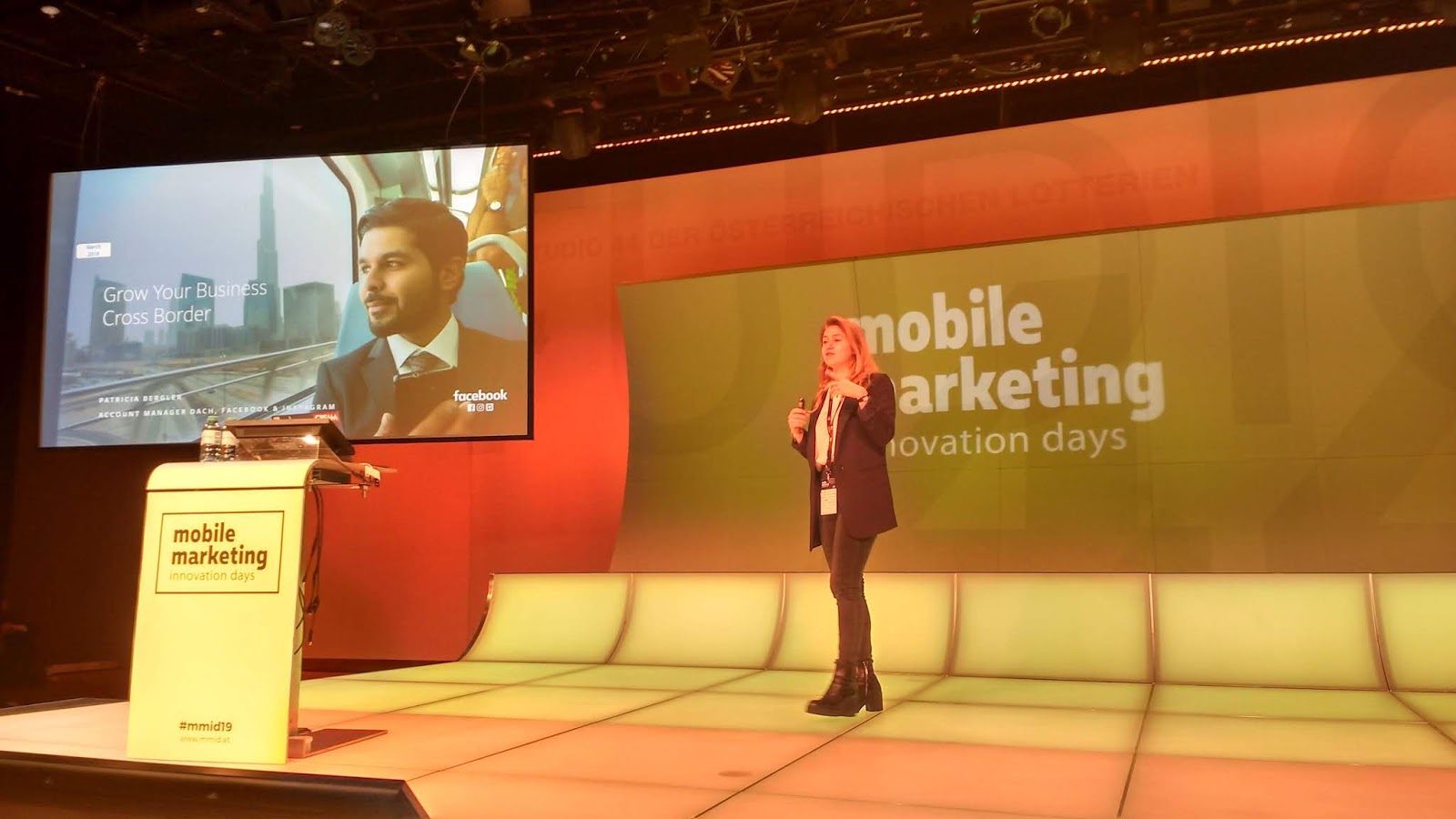
| Keynote speaker Patricia Bergler of Facebook on stage |
Entrepreneurs
are supposed to spend time and money on client acquisition when business is
good so that they will be prepared for rainy days. This is why Dagy decided to
try to expand her client base at a time when she was really busy,
following a slow start
into the new year. Still, spending 400 euro on a 1.5-day conference that
wouldn’t be relevant for me as a linguist (but all the more as a consumer) wasn’t an
easy decision. Luckily, I ended up getting a coupon for 20% off and I was ready
to attend the “Mobile Marketing Innovation Days” in Vienna. I quickly learned that the buzzword “mobile
marketing” simply refers to tools and strategies used to sell products (and
sometimes services) online using apps. Also, I learned that these sales are
mostly done on people’s phones. The speaker line-up at the conference was quite
impressive, with some of them working for the big players in the industry,
including Google, Facebook, and the likes. The speakers from Google stood out
for their professionalism and they also came across as really likeable, also
because they emphasized that privacy was holy to them. Which is something I
truly wanted to believe, given the huge amounts of data I share with Google on
a voluntary basis every day.
The
linguist in me heroically ignored language-related hiccups in the conference
program (German/English) and elsewhere and focused on my primary goal:
networking.
With a
total of roughly 400 participants (most of them considerably younger than me),
the conference was a good choice in terms of size because it seemed manageable
and not too overwhelming. A plus was that everybody was on a first-name basis,
which seems to be common in this hip and young industry and which made starting
a conversation much easier. As expected, the presentations per se were mostly
irrelevant for my job, but interesting from a user’s perspective. Among others,
I enjoyed learning about online crime from a representative of Europol, the EU
law enforcement agency.
![]() |
| Branded chocolates for everyone (no calories!) |
Ultimately,
the reason I attended the conference in the first place was the networking during
breaks and after or before presentations. Other than a trained translator who now
works in online marketing, I was the only translator/interpreter in sight. This
fact alone ensured people’s attention when I introduced myself and I soon took
to referring to myself as an “exotic species” at the conference. I always used
my “ice-breaker question” about the difference between translating and
interpreting, which works every time to get a conversation started. Many of the
people I spoke to showed interest in my services, from marketing agencies to a
pharmaceuticals company, a government agency, a university department, etc.
Each and every time, I conveniently ended up talking to the person most likely to
need my services, which are people working in marketing and communication
departments. Talking to the person sitting next to me before and after
presentations also turned out to be a good networking approach.
Even though
it was an easy-going crowd, networking can be an exhausting exercise. For those
who needed a little pick-me-up, vodka-based cocktails were being served as
early as in the morning, thanks to a sponsor, which is certainly unheard of in
the US. Drinks in hand, participants avidly exchanged old-fashioned business
cards. Needless to say that it is very important to follow up on these contacts
shortly afterwards using LinkedIn and/or Xing.
Here are a
few takeaways from my client acquisition project at a marketing conference:
- Don’t expect it to be easy. Making conversation with people can be hard, especially outside the US. Make sure you are willing to approach people and start a conversation. Don’t expect others to do it.
- If you don’t feel like you’re in a great networking mood on the day of the event, motivate yourself and set some realistic goals such as having a meaningful conversation with three or five people and getting their business cards. I also recommend having a few funny translating/interpreting anecdotes handy. Everybody loves a good story! Asking the other person questions about their job, etc. always works, too. Who doesn’t like talking about themselves?
- Bring a little something. After introducing yourself, go ahead and use our favorite icebreaker mentioned above. Give a small “prize” to those rare people who get in right and to those who gave it the good old college try. Years ago, I had small chocolates with my logo and my contact information made for that purpose (see below, it’s for “Texterei,” the European side of our business). People loved it!
- Cut yourself some slack. Even though you have paid to attend the entire conference, don’t feel bad if you skip a session or two or go home early. After all, networking is not so much about quantity than about quality, but be sure to talk to a fair amount of people.
Last but
not least, here is the big question: Did this marketing effort pay off? The
success of marketing efforts is generally hard to measure and if at all, time
will tell. My presence at this conference might result in future
translating/interpreting jobs or somebody might share my contact information –
who knows. One thing is for certain: meeting new people is always an enriching
experience, both from a professional and a personal perspective. Needless to
say, the chances of getting new jobs will increase with a linguist’s
visibility, both online and offline. My bottom line was this: I had fun, I got
great insight into an industry previously unknown to me, it was sometimes
exhausting (after all, it was work) and I am already planning on attending
other small conferences in Vienna.
New Client, New Payment Practices
Oftentimes we only hear bad news about payment practices in our profession, so we figured we'd share some good news instead.
Earlier this week, we received a phone call from a Las Vegas law firm we know that had not previously been a client. Their translation needs were urgent and required us to drop everything, cancel dinner, and work a few hours in the evening to get it done. We usually ask for a deposit for new clients, but this was a last-minute and urgent request, so we used the highly scientific method known as gut feeling (which mostly works) and started working on the project right away. It was a small, yet intense team effort, and we delivered the project the next day a few hours before the agreed-upon deadline. We e-mailed the invoice at the same time as the project, and we received payment in the form of a check the very next day, which is a new record. We've received electronic transfers the very same day, but never a check from a brand-new client the very next day. We are not quite sure how they got it to us so quickly except that they must have prepared the check as soon as they received the quote (talk about trust!). Either way, we are very grateful for the quick payment and sent the client an e-mail to thank them.
So in spite of the many negative comments about client payment practices you may read, there are some great clients out there indeed. What about you, dear colleagues? We'd love to hear your best payment-related story!
Learn from the Best: Interpreting Training with Darinka Mangino
A few months ago, we both had the pleasure of meeting Mexican presidential interpreter Darinka Mangino at the ATA conference in New Orleans, and we had a great time. She reminds us a bit of our dear friend, the late and dearly missed Esther Navarro-Hall. Darinka is a member of AIIC one of our interpreting heroes with more than 3,000 days (!) of interpreting at the very highest level (learn more about here here by viewing this cool video and this Spanish-language podcast). When we heard about her online module-based interpreting training courses, Judy jumped at the chance to polish her skills. The class runs 8 weeks and starts January 7, 2019. Here's more information if you'd like to join us in getting a jump start on professional development in 2019.
Course name: On-line Refresher Course on General Issues Related to Interpreting Module 1
Instructor: Darinka Mangino, AIIC
Platform: Adobe Connect
Dates: Every Monday starting January 7 through April 29, 8 p.m. Mexico City time (Central Time in the U.S.)
Duration: 70 minutes per session
Presenting language: Spanish
ATA continuing education points: 10
Language: Spanish
Cost: MX$5,352 for ATA members and a number of other organizations (approx. USD 270)
Sign-up: https://www.eventbee.com/event?eid=133063102#/tickets
Course overview:
Course name: On-line Refresher Course on General Issues Related to Interpreting Module 1
Instructor: Darinka Mangino, AIIC
Platform: Adobe Connect
Dates: Every Monday starting January 7 through April 29, 8 p.m. Mexico City time (Central Time in the U.S.)
Duration: 70 minutes per session
Presenting language: Spanish
ATA continuing education points: 10
Language: Spanish
Cost: MX$5,352 for ATA members and a number of other organizations (approx. USD 270)
Sign-up: https://www.eventbee.com/event?eid=133063102#/tickets
Course overview:
1L
|
Español mexicano
|
10L
|
Organización de glosarios
|
2L
|
Preparación
|
11L
|
Contextos ONU
|
3L
|
Contextos politicos
|
12L
|
Agilidad léxica
|
4L
|
Voz
|
13L
|
Velocidad
|
5L
|
Acentos
|
14L
|
Autoevaluación
|
6L
|
Investigación documental y terminológica
|
15L
|
Contextos artÃsticos
|
7L
|
Contextos legales
|
16L
|
Escucha y atención
|
8L
|
Memoria
|
17L
|
Simultánea con texto
|
9L
|
Números
|
Stockholm Syndrome
![]() |
| Stockholm in September. Photo by Judy. |
Some clients are just not good clients. If you have a client who repeatedly does not pay you and keeps on asking you to take on more work, either politely decline or ask for payment up front. No need to feel bad for them. You need to look out for your business interests, which mainly include getting paid for services rendered.- Some clients are abusive. We've all heard the stories: there are clients who are so unreasonable that they are having a negative effect on your mental health. These are few and far between, but if this ever happens to you, you need to walk away without feeling bad. You should actually feel very good about the fact that you are not an employee but a contractor or freelancer, which means you are free to work or not work with whoever you choose. We agree that walking away from good work can be hard, but even if the work is good, there's no reason you should put up with an abusive client. Of course there's no one definition of what "abusive" means, as we all have different levels of tolerance, but in our book if you are thinking about a specific client more than you want and those thoughts are stressful, it's time to say good-bye, in a very professional and friendly way.
- Speaking of saying good-bye: We oftentimes get the question about how to exactly phrase it. You need to use your own style and tone when drafting these messages, but here are some ideas. You don't necessarily have to give a reason, but you certainly can if you would like to (we prefer to keep things very short and spend as little time on it as possible to cut our losses).
- "Thank you very much for your interest in my services. I hereby kindly inform you that I will not be working with your firm/company in the future."
- "Thank you for your past business. It's been my pleasure to provide top-notch services for your firm/company, but I will not continue to do so in the future. Kindly remove me from your list."
- Option 3: Do nothing, don't respond, and perhaps (in extreme cases) block the sender. This is not an option we would go with, but it certainly might be an idea.
What do you think, dear colleagues? Have you suffered from Stockholm syndrome? If yes, how did you resolve it? We'd love to hear from you.
Do You Suffer From Interpricide?
![]() |
| Does Nicole Kidman suffer from this? Probably not. |
A few months ago, we received an email from our colleague Sarah
Glendenning in Manchester, UK. We had not met her in person, and we always
enjoy hearing from “new” colleagues, especially those in sign interpreting
languages. We have to admit that we do a poor job at reaching out and
collaborating with our colleagues in the sign languages interpreting
profession, so we are thrilled that Sarah approached us to get our thoughts
from the spoken languages interpreting perspective about something that Sarah,
a registered BSL (British Sign Language) interpreter has termed interpricide.
Let’s have her explain it in this interview. She previously wrote an article
about this same topic for Newsli, the quarterly magazine for members of ASLI
(The Association of Sign Language Interpreters) in 2009.
Translation Times: Thanks for
speaking to us! We’d never heard of interpricide until you contacted us. Can you explain what it is?
Sarah: Interpricide is a term myself and a colleague
came up with back in 2009 at a conference of the Association of Sign Language
Interpreters (ASLI). A call was sent out
for interpreters to interpret at the conference and we were trying to persuade
our peer group that it would not be “interpricide,” that is, the fear of
committing professional suicide by interpreting in front of other
interpreters. It was very much a tongue
in cheek phrase but resonated with a lot of people in the room. It struck me that it is actually a real
fear. Interpricide is “the act of
committing professional suicide by interpreting in front of your peer group”
(Llorca and Glendenning 2008). I seem to
remember Karl and I getting a lot of requests from student interpreters to read
our article, we had to turn them down as an article hadn’t actually been
written!
Translation Times: What is your goal
in terms of talking about interprecide? Academic research? Awareness-building? How can we help?
At the moment it is purely for awareness building so linguists
can start having these conversations. It is something that intrigues me and am
looking forward to investigating this further by using different
academic/medical theories. From the interpreters I have spoken to informally,
many have stated they felt an increased pressure when they knew people in the
audience could monitor both the L1 and L2 being used. At this stage I am not sure if other
professions have the same feelings or whether it is just within the
interpreting field.
Translation
Times: Have you personally experienced interpricide?
Sarah: Most definitely. Not so much now because I’ve been on the
circuit for a long time, but when I was a trainee and newly qualified most
definitely. I was involved in a
conference and my team consisted of four experienced interpreters plus
myself. We were a great team. However, when I took to the stage to start
interpreting, the footlights dimmed and I could see the audience, I could see
in the audience some of my professors from University, ex bosses from different
in-house positions I had held, some of the assessors who had marked my work
throughout interpreter training and also some interpreters who in my view were
demi gods and I looked up to them.
I remember looking at my hands (being a sign language
interpreter), and the meta notative comments in my head were on overdrive. What had I been signing? Did it make any sense? Was I even good enough to be there? (Impostor
Syndrome). What were my options? (Fleeing was a strong urge). My hands were sweating, my throat went dry, and my knees were
shaking, but why? Some interpreters will
say interpricide is not a thing but for me it really is.
Now I have a question for you. Have you experienced interpricide
as spoken languages interpreters? Have you seen it happen in your profession?
I’d love to know more.
Translation Times: Good point. We
hadn’t really thought about it too much until you brought it up – wait, we had
thought about it, but we just didn’t have a name for it. Spoken language
interpreters tend to be less “exposed” than sign language interpreter
colleagues, because we don’t often stand in the front of a room. For our answer
we will focus on conference interpreting in a booth first. In this situation,
you always have a colleague sitting inches from you, and she or he is obviously
quite able to evaluate your performance. There are certainly some nerves
involved when you interpret next to a more experienced colleague, and we’ve
seen it happen that some interpreters are unable to interpret at all and can’t
get a word out. It doesn’t happen very often, and we don’t know if it happens
because the interpreter is so intimidated by the colleague or simply
overwhelmed by the task at hand. It could be both.
Now in legal interpreting,
especially in the United States, you mostly work on your own with the
exceptions of longer hearings and trials, for which we use team interpreting.
However, oftentimes you will be in a courtroom with multiple interpreters
(could be for several different languages) who are waiting for their cases to
come up, or you may have an interpreter for both plaintiff and defendant, so in
those cases your performance is also quite public to your colleague. That can
be scary for interpreters, especially newly certified ones, and we will be the
first ones to admit that it’s certainly made us nervous in the past. A few
years ago, Judy interpreted in federal court next to a fellow federally
certified Spanish interpreter she admires and turns out that the client had
made a mistake and had double-booked the interpreters. So, both were there and
Judy’s colleague asked Judy to go ahead and start interpreting and they’d take
turns if the hearing lasted more than 20 minutes. It didn’t, and Judy
interpreted the entire thing herself – while being quite nervous under the
watchful eye of her more experienced colleague (for the record: everything went
very well). For legal assignments that are not held in court, but usually at
law firms, you could be in the situation that you are in, for instance, an
arbitration for which both plaintiff and defendant have an interpreter. You’d
sit on opposite ends of the table of the other interpreter –which can be
uncomfortable for some, especially because you’ve been retained by opposing
parties (even though we are, of course, neutral parties). Finally, some law
firms have started hiring what is called “check
interpreters,” a term we hadn’t heard
until a few years ago. For instance, if the firm represents the plaintiff and
the plaintiff is called in for a deposition (meaning they give testimony under
oath) and the interpreter is hired by a third party (oftentimes the
court-reporting firm), sometimes the plaintiff law firm will retain their own
interpreter to check on the first interpreter. This is a new procedure, and the
rules of professional behavior for interpreters (When should we intervene? How?
What is inappropriate?) are still being defined. We are of two minds about
this: it does seem troubling that interpreters are, essentially, not trusted,
hence the check interpreter. We do have court certifications for a reason, and
we are certainly trustworthy as professionals. The check interpreter system
also puts both interpreters in an uncomfortable, sometimes adversarial
position. On the other hand, this system can potentially double the amount of
work available to court interpreters, so that’s a significant positive.
In general, we think all
interpreters must have experienced some interpricide at one point in their
careers – it’s only natural, and being surrounded by qualified professionals
who can actually evaluate your performance keeps you humble and honest, so it’s
not necessarily a bad thing.
Twin Translations: Thanks so much
for your time and for telling us about this very interesting topic. Is there
anything else you’d like to add?
I would love to know whether spoken language interpreters have
similar experiences, so thanks for getting things started and sharing your own
experiences here. As a sign language interpreter I am visually present in the
room and therefore more accessible. It would also be great to see interpreters come together. It doesn’t
matter which language we use; we can all learn from each other. Thank you for involving me in this blog. I welcome your comments! My Twitter handle is
@sginterpreting #interpricide.
About Sarah:
A registered sign language
interpreter based in the UK. Passionate about her work and dedicated to
teaching and training other interpreters.
A mentor and a member of ASLI (The Association of Sign Language
Interpreters), regulated under The NRCPD (National Registers of Communication
Professionals working with Deaf and Deafblind
People). Widely read and open to discussion. Website: www.sginterpreting.co.uk
Job Posting: Assistant Professor of Translation/Spanish
Happy Friday, dear readers! A few days ago, our colleague Adam Wooten sent us this job announcement, and we are happy to share. There aren't that many job openings for full-time tenure-track translation professors in the U.S., and this one is a hybrid, as it's a combined Spanish/translation teaching position. It's at Weber State University in Utah, located north of Salt Lake City.
Please note that we are not involved in the hiring process and cannot answer any questions about the position -- sorry! We are merely posting this job in the hopes that one of our fantastic colleagues is interested in it. Keep us posted if you apply, which you can do here.
A Blind Certified Medical Interpreter's Job Search
More than six years ago, Judy met the unstoppable blind Spanish/English certified medical interpreter Jamey Cook (CMI) and her late seeing eye dog, Abner, at a conference in North Carolina, and a friendship developed. In 2014, Judy wrote a story about Jamey for the ITI Bulletin, which made the cover of the January-February issue (see picture). They've been in touch ever since, and it's been lovely to see that Jamey landed a full-time OPI (over-the-phone interpreting) position a few year ago. Unfortunately, Jamey and her entire OPI department were recently laid off. Now, losing a full-time interpreting position is difficult, especially since there aren't that many in this country, and it's especially difficult for someone like Jamey who has limitations -- which have, of course, barely stopped her. So we thought instead of us posting job openings on our blog, which we frequently do, let's flip this around, profile Jamey and announce it here that she's looking for a job. Our goal is to spread the word about Jamey's job search and hopefully match this talented medical interpreter with an amazing employer.
Jamey in a nutshell:
- Jamey Cook holds a master's degree in Spanish from the University of North Carolina at Chapel Hill
- She's a certified Spanish/English medical interpreter (CMI; certified by the National Board of Certification for Health Care Interpreters). She is one of only a handful blind certified medical interpreters in the country.
- She has more than eight years' experience as a medical interpreter (OPI)
- Jamey resides in North Carolina and is looking for a full-time job from home
- If you are interested in interviewing/hiring Jamey, please either email her at jamey(dot)cook(at)gmail(dot)com or leave a comment and we will put you in touch.
So now it's the interpreter community's turn: is Jamey's dream job out there? Can you help her find it? Let's do this, fellow terps!
Free SDL Webinar: Pricing Skills for Translators and Interpreters
Just like last year, Judy is delighted to be giving another webinar for our friends over at SDL -- and it's free for everyone (you just have to sign up). The title is: Tell me how to price my translation services, and here's a brief description of what you can expect to learn:
We translate and interpret because we love it, but we also want to make sure we get compensated well for our professional services. Having a well-developed pricing strategy is key to linguists’ satisfaction and success – but what are some of the economic factors you must take into consideration? How can you make sure you don’t get paid peanuts, what does inflation have to do with anything, and what’s price differentiation?
In accordance with prevailing anti-trust legislation, no pricing recommendations will be made. However, attendees will be presented with practical advice and food for thought that they can implement immediately. Join Judy to talk pricing and learn to not be afraid of this key topic – it can be rewarding.
Here's the link to sign up. SDL is based in the UK, so the event will be held on Friday, November 8, at 3 pm GMT, which is 7 am Pacific and 10 am Eastern. "See" you there?
Court Interpreting in Nevada: Two New Trends
As a federally certified Spanish court interpreter, Judy spends a lot of time in the federal courts around the Southwest, but she also works in judiciary assignments outside of court (depositions, arbitration, attorney-client meetings). As challenging as court interpreting is, regardless of the setting or the mode of interpretation, after a decade or so, you do learn to anticipate quite well, as cases seem to fall within certain categories and can become repetitive. However, every once in a while you notice new trends and new cases coming through the system, which require some investigation and study to be able to interpret at a high level. Here are two that Judy has noticed this year (please note that these topics are quite serious and not for the faint of heart):
![]() |
| Photo credit: https://tinyurl.com/yctxq3w5 |
1) Fentanyl (fentanilo in Spanish): Anecdotally, before the beginning of this year, I'd say I'd only seen one or two of these cases in my entire interpreting career. This year, these types of cases have exploded, at least from my perspective as a court interpreter, and that seems to be in line with the national trends. Fentanyl is a synthetic opiate that's some 100 times more potent than morphine (having gotten one post-surgery morphine injection that knocked me out, I find it hard to process that fentanyl is 100 times stronger). It is also many times stronger than heroin, its synthetic cousin. As you would expect, it's highly addictive and dangerous. It's a Schedule I narcotic under the federal courts, and I've seen an increased amount of defendants accused of trafficking fentanyl into the country (oftentimes mixed with heroin or cocaine). I found these links helpful in trying to learn more about this synthetic substance, which is also used as an anesthetic and short-term pain reliever (the use it was originally designed for): Why fentanyl is deadlier than heroin, What is fentanyl?, DEA drug sheet on fentanyl , The fentanyl crisis is so deadly in Canada that even funeral directors need the antidote, Fentanyl is fueling a new overdose crisis.
2) MS-13 (Mara Salvatrucha), an international criminal gang: I mostly work in Nevada, California, and New Mexico, and many defendants in criminal drug cases have some affiliation, as marginal as it may be, to Mexican cartels. I know their lingo well as I have spent years interpreting for them. However, MS-13, a Salvadorean-American street gang that got its start in Los Angeles in the 1970s, is relatively new to me. While I have attended several conferences on MS-13 to learn terminology and get general insight, I'd rarely interpreted for these defendants before. I've recently seen an increase in cases involving MS-13 in my part of the country, and I've had to quickly pick up new terminology (such as paro for "errand boy"). Interpreting gruesome details related to violence is never easy, but the amount of violence inside MS-13 is particularly difficult to stomach, even for an experienced court interpreter. In theory, interpreters can recuse themselves from any case, but I have never done that; I just focus on the job, which is to interpret, regardless of what is being said and of how it makes me feel. Here are some articles that have helped me learn more about MS-13 (warning: explicit content): MS-13 Gang Member Pleads Guilty in Quadruple Murder Highlighted by Trump, MS-13, explained, What You Need to Know About the MS-13 Street Gang.
What about you, dear fellow court interpreters? Which new trends are you seeing? How do you learn more about new topics? We'd love to hear your tips and tricks.
Subscribe to:
Posts (Atom)
Join the conversation! Commenting is a great way to become part of the translation and interpretation community. Your comments don’t have to be overly academic to get published. We usually publish all comments that aren't spam, self-promotional or offensive to others. Agreeing or not agreeing with the issue at hand and stating why is a good way to start. Social media is all about interaction, so don’t limit yourself to reading and start commenting! We very much look forward to your comments and insight. Let's learn from each other and continue these important conversations.